How to Avoid 200% Penalty Under Section 270A: Complete Guide to Section 270AA Immunity (Post Finance Act, 2026)
Receiving an assessment order with additions followed by a penalty show-cause notice under Section 274 read with Section 270A is one of the most challenging situations an Indian taxpayer can face. When the Income Tax Department classifies an addition as "misreporting of income", it triggers a mandatory, non-negotiable penalty of 200% of the tax payable under Section 270A(8).
Until recently, if the Assessing Officer (AO) invoked misreporting under Section 270A(9), statutory immunity under Section 270AA was completely barred. Taxpayers had no choice but to face multi-tier litigation before CIT(Appeals), the ITAT, and higher courts.
The Finance Act, 2026 has introduced a critical legislative route: Section 270AA has been amended (effective 1st March 2026 for AY 2026–27 and earlier assessment years) to extend statutory immunity even to cases where penalty proceedings have been initiated for misreporting.
1. Statutory Mechanism: Section 270A vs. Amended Section 270AA
Under-Reporting vs. Misreporting
Section 270A distinguishes between standard under-reporting and deliberate misreporting:
- Under-Reporting (Section 270A(2)): Attracts a penalty of 50% of the tax payable.
- Misreporting (Section 270A(9)): Attracts a penalty of 200% of the tax payable.
The statute defines six exhaustive limbs under Section 270A(9) that constitute misreporting:
- Misrepresentation or suppression of facts.
- Failure to record investments in books of account.
- Claim of expenditure not substantiated by any evidence [Section 270A(9)(c)].
- Recording of false entries in books of account.
- Failure to record receipts in books of account affecting total income.
- Failure to report international or specified domestic transactions.
The Finance Act, 2026 Immunity Window
Under the amended Section 270AA, an assessee can now apply to the Assessing Officer for grant of immunity from the imposition of penalty under Section 270A and statutory immunity from prosecution under Section 276C or Section 276CC, subject to fulfilling these conditions:
- Tax and Interest Payment: Payment of the tax and interest specified in the demand notice under Section 156 within the statutory period.
- Additional Income-Tax: Where penalty is leviable under Section 270A(9) (misreporting), payment of additional income-tax amounting to 100% of the tax payable on the under-reported income (in lieu of the 200% penalty).
- Waiver of Appeal: An explicit undertaking confirming that no appeal has been or will be preferred against the assessment order under Section 246A or Section 249.
- Timely Submission: Filing Form 68 electronically within one month from the end of the month in which the order was received.
2. Comprehensive Model Scenario (Reconciled Figures)
To see how the numbers reconcile across the assessment order, computation sheet, interest calculations, and immunity challan, let us consider a fully structured model case.
Case Parameters
- Assessment Year: AY 2021–22 (Old Tax Regime)
- Original Return (Processed u/s 143(1)): Total Income declared = ₹6,00,000
- Reopening u/s 148: The taxpayer originally claimed an ₹8,00,000 deduction under Section 80GGC. After receipt of a Section 148 notice, the taxpayer withdrew the deduction in the reassessment return, declaring ₹14,00,000, and deposited ₹4,50,000 via self-assessment tax to cover the resulting tax and interest.
- Final Assessment Order u/s 147: The AO accepted the ₹14,00,000 returned income but made further disallowances of ₹6,00,000 under Section 37(1) for unsubstantiated referral commission and office expenses.
- Final Assessed Total Income: ₹20,00,000
- Penalty Initiation: Penalty notice issued under Section 274 read with Section 270A, citing Section 270A(2)(a) and invoking misreporting under Section 270A(9)(c) for unsubstantiated business debits.
3. The Math: 200% Penalty Exposure vs. Section 270AA Immunity
Step 1: Quantifying "Under-Reported Income"
Under Section 270A(3)(i)(a), when an assessment is made under Section 147 for the first time, under-reported income is calculated against the original Section 143(1)(a) baseline:
Assessed Income (₹20,00,000) − Processed Income u/s 143(1)(a) (₹6,00,000) = ₹14,00,000
Step 2: Computing Tax Payable on Under-Reported Income
Under Section 270A(10), the tax payable on under-reported income is the difference between tax on assessed income and tax on the originally processed income (calculated at AY 2021–22 slab rates with 4% Health & Education Cess):
|
Calculation Step |
Particulars |
Base Tax (₹) |
Cess @ 4% (₹) |
Total Tax (₹) |
|
A |
Tax on Assessed Income of ₹20,00,000 |
4,12,500 |
16,500 |
4,29,000 |
|
B |
Less: Tax on Original Income of ₹6,00,000 |
32,500 |
1,300 |
33,800 |
|
C |
Tax Payable on Under-Reported Income (A − B) |
— |
— |
3,95,200 |
Step 3: Comparing the Financial Outcomes
|
Parameter |
Route 1: Contesting Penalty (Merits) |
Route 2: Section 270AA Immunity |
|
Statutory Charge |
Misreporting u/s 270A(9)(c) |
100% Additional Tax u/s 270AA(1)(b) |
|
Exposure / Outgo |
200% Penalty = ₹7,90,400 (2 × ₹3,95,200) |
100% Tax = ₹3,95,200 |
|
Net Savings |
Nil (High loss risk on cash/referrals) |
₹3,95,200 (Exact 50% Reduction) |
|
Prosecution Risk |
Active exposure under Section 276C |
Complete statutory immunity |
|
Resolution Time |
3 to 7 years in appellate litigation |
Concluded in 90 days |
4. Assessment Interest and Demand Reconciliation
A common point of confusion arises when an addition of ₹6,00,000 results in an assessment demand notice showing ₹0 Demand or even a Refund:
|
Step |
Ledger Head |
Amount (₹) |
|
1 |
Gross Tax on Assessed Income (₹20,00,000) |
4,29,000 |
|
2 |
Incremental Net Interest (Sections 234B, 234C, 234D) |
21,000 |
|
3 |
Total Assessment Liability (1 + 2) |
4,50,000 |
|
4 |
Less: TDS Credit available |
1,20,000 |
|
5 |
Less: Self-Assessment Tax paid during Section 148 filing |
4,50,000 |
|
6 |
Total Taxes Paid (4 + 5) |
5,70,000 |
|
7 |
Net Adjustment (3 − 6) |
−1,20,000 |
|
8 |
Less: Refund already issued in initial 143(1) processing |
−80,000 |
|
9 |
Net Balance Refundable / Demand Payable |
−₹40,000 (Refund Due) |
Why Did Interest Stop Accumulating?
Under Section 234B(2), interest ceases to run on the portion of tax already deposited. Because the taxpayer made a substantial payment of ₹4,50,000 when filing the return in response to Section 148, that capital absorbed both the withdrawn deduction and the subsequent addition. As the department held surplus funds, interest stopped accumulating, and the Section 156 demand notice correctly shows ₹0 Demand.
5. How to Pay the Additional 100% Tax for Section 270AA
To ensure the immunity application is valid, the challan must be filed correctly on the e-filing portal:
|
Portal Field |
Correct Selection |
Guidance |
|
Portal Path |
e-File → e-Pay Tax → New Payment |
Access via the Income Tax portal |
|
Assessment Year |
2021–22 (Select the order's specific AY) |
Do not select the current AY |
|
Major Head |
Income Tax (Other than Companies) (0021) |
Applicable for non-corporate assessees |
|
Minor Head |
Tax on Regular Assessment (400) |
Directly credits against the assessment order |
|
Tax Amount |
Enter ₹3,95,200 in the "Tax" row |
Leave Surcharge, Cess, and Penalty as ₹0 |
Payment Tile | Demand Payment as Regular Assessment Tax (400) | Select Proceed on this tile |
Demand Selection | Demand Payment under Minor Head-400 without DRN | Use this link when the payment is not listed against a DRN |
Type of Payment | Outstanding Demand (Regular Assessment Tax) (400) | Confirm the order’s assessment year before continuing |
Amount Break-up | Enter ₹3,95,200 in Tax | Keep Surcharge, Cess, Interest, Penalty and Others at ₹0 for this worked example |
Step-by-Step Challan Payment Screens
Follow these screens in sequence. The figures use the article’s worked example for Assessment Year 2021–22 and additional income-tax of ₹3,95,200. Use the assessment year and amount applicable to your own order.
-
Open New Payment and choose Demand Payment as Regular Assessment Tax (400). Click Proceed.
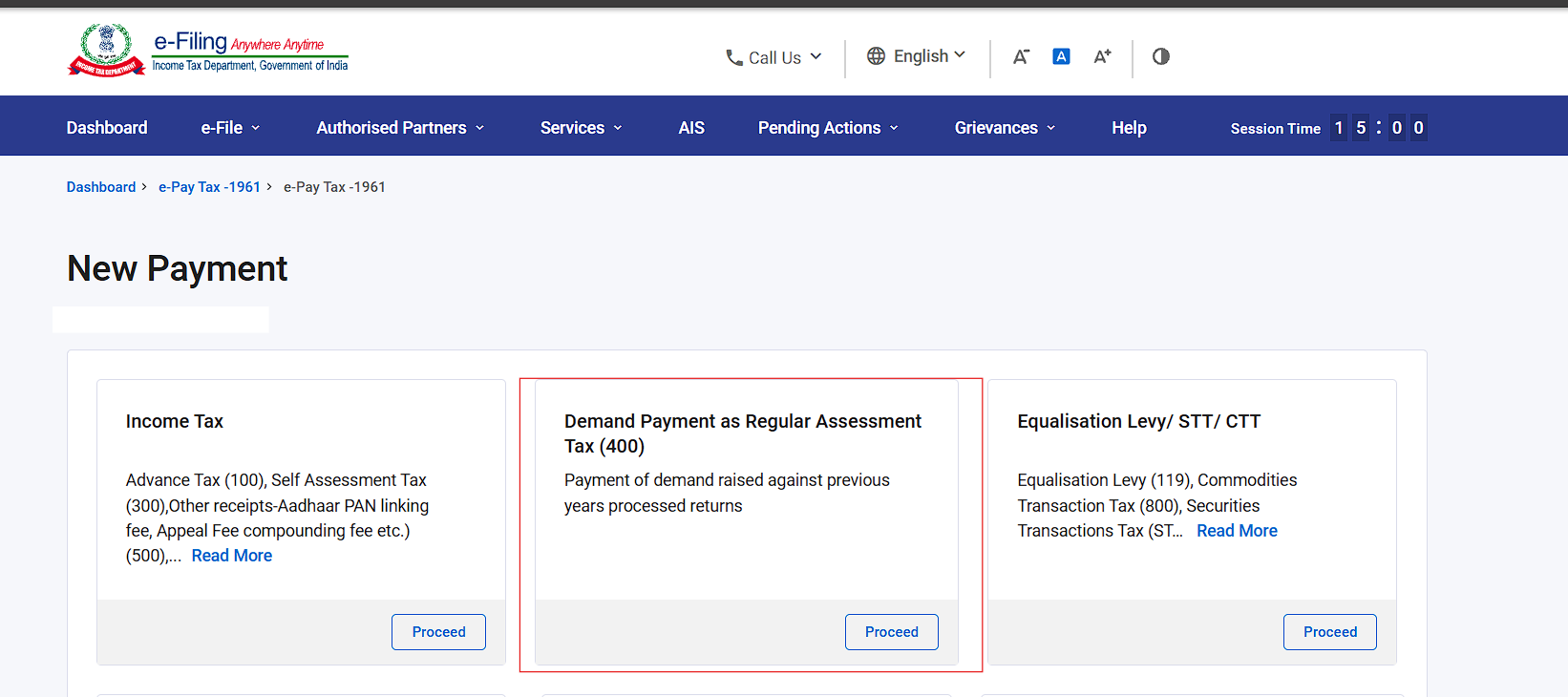
Step 1: Choose Demand Payment as Regular Assessment Tax (400). -
Select Demand Payment under Minor Head-400 without DRN.
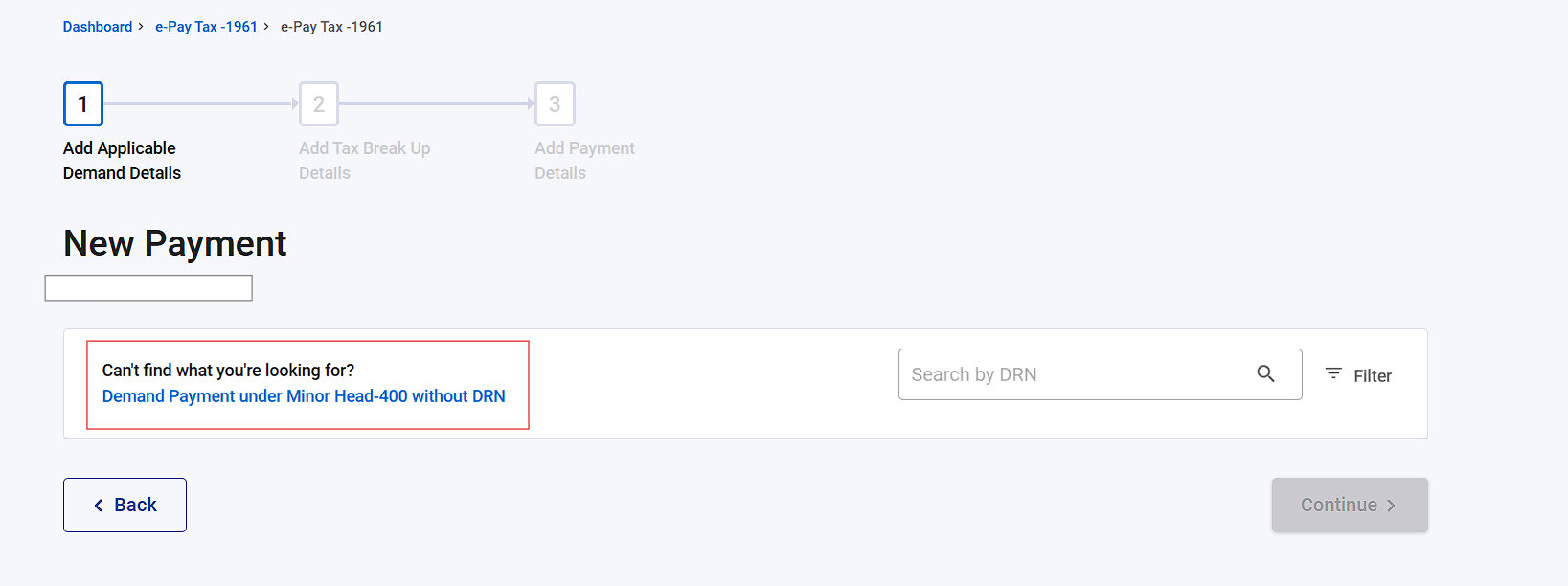
Step 2: Continue without a DRN where the demand is not listed. -
Select the assessment year stated in the order. Under Type of Payment, confirm Outstanding Demand (Regular Assessment Tax) (400), then click Continue.
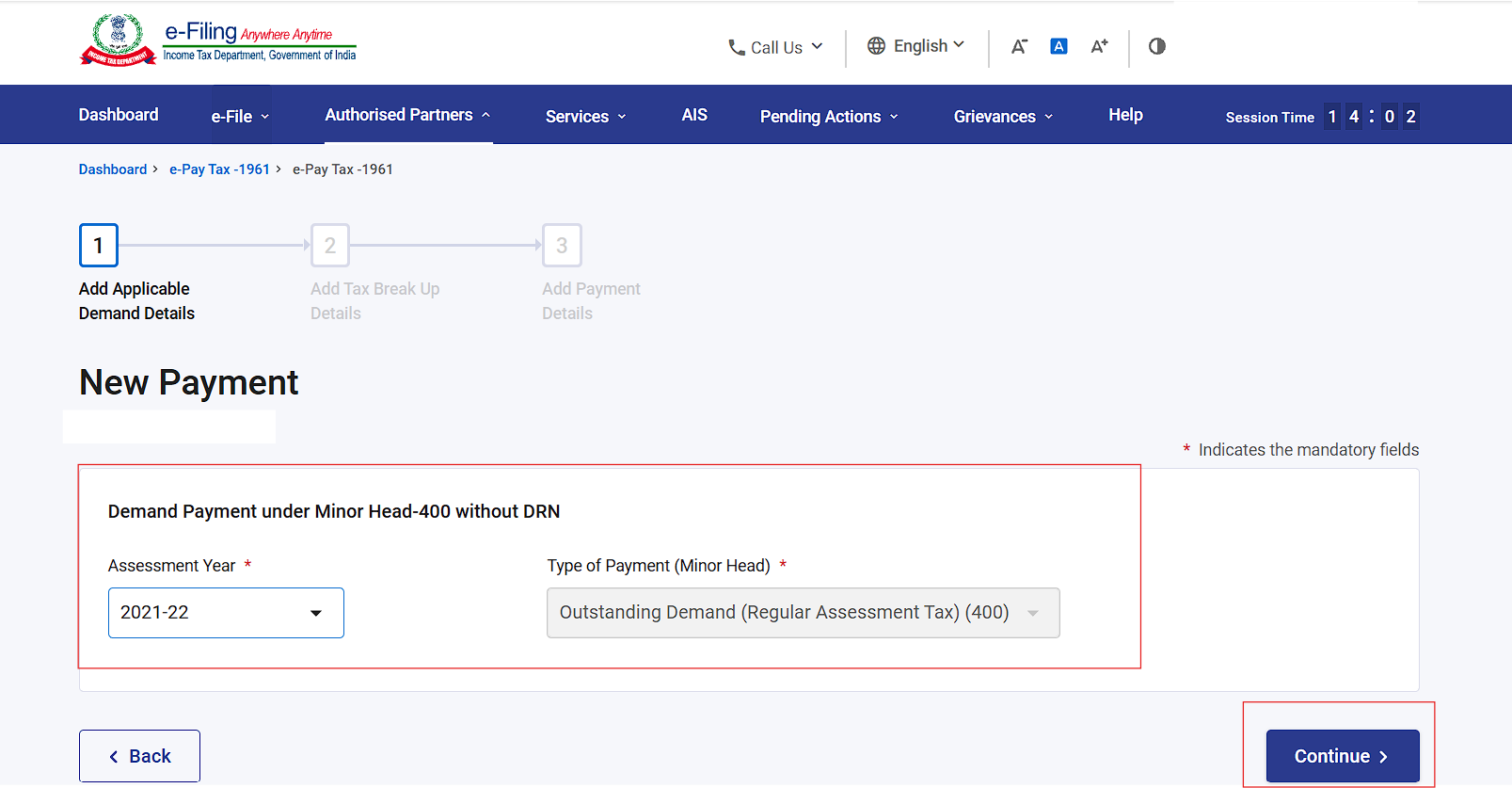
Step 3: Select the order’s assessment year and payment type 400. -
Enter the additional income-tax in the Tax row. In this example, enter ₹3,95,200 and keep Surcharge, Cess, Interest, Penalty and Others at ₹0. Verify the total before continuing.
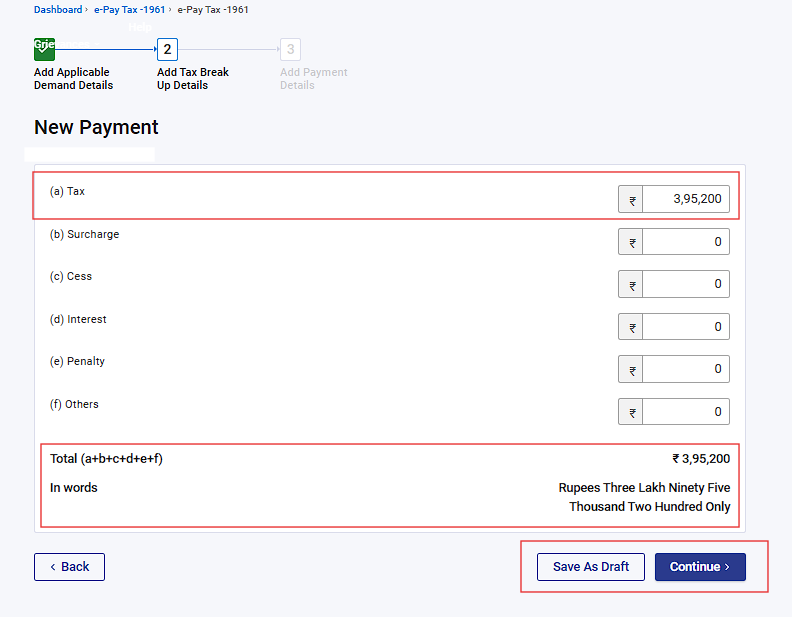
Step 4: Enter the worked-example amount in Tax and verify the total.
Important: Download and preserve the paid challan receipt showing the BSR Code and Challan Identification Number (CIN).
Note: Surcharge and cess are already factored into the statutory tax computation on under-reported income. Download and preserve the paid receipt showing the BSR Code and Challan Identification Number (CIN).
6. Procedural Roadmap & Timelines
[Day 0: Assessment Order & Penalty SCN Received]
│
├─► Within SCN Time Limit (usually 7–15 days):
│ Submit Interim Holding Reply to Penalty Notice under Section 274
│
├─► Within 30 Days of Order:
│ Do NOT file an appeal before CIT(Appeals) in Form 35
│
├─► Before End of 1 Month from Month-End of Order:
│ Pay Additional Income-Tax (Challan 400) & Submit Form 68
│
└─► Within 3 Months of Form 68 Month-End:
AO passes statutory order granting immunity under Section 270AA(4)
Action 1: File an Interim Reply to the Section 274 Notice
Penalty show-cause notices usually give a 7 to 15-day window to respond.
- Action: Submit an electronic reply under e-Proceedings:
"The assessee is availing statutory immunity under Section 270AA as amended by the Finance Act, 2026. The requisite additional income-tax under Minor Head 400 is being deposited and Form 68 is being submitted. It is respectfully requested that penalty proceedings under Section 270A be kept in abeyance pending disposal of Form 68."
Action 2: Waive Appeal Rights
Filing an appeal under Section 246A or Section 249 automatically invalidates an application under Section 270AA. Ensure no Form 35 is submitted.
Action 3: File Form 68 Within the Statutory Window
Under Section 270AA(2), Form 68 must be submitted within one month from the end of the month in which the assessment order was received.
- Example: If an order is dated 08-09-2026, the month ends on 30-09-2026. The statutory deadline to file Form 68 is 31-10-2026.
- How to submit: Portal → e-File → Income Tax Forms → File Income Tax Forms → Form 68.
- Fill in the Assessment Order DIN, select the relevant clause covering Section 270A(9) misreporting, attach the paid challan receipt of ₹3,95,200, and verify via Aadhaar OTP or DSC.
Action 4: Order Granting Immunity (Section 270AA(4))
The Assessing Officer is statutorily required to pass an order granting or rejecting immunity within three months from the end of the month in which Form 68 was received. Once granted, the order provides finality: no further penalty under Section 270A can be levied, and no prosecution under Sections 276C/276CC can be initiated.
7. Strategic Evaluation: When to Settle vs. When to Appeal
|
Factor |
Option 1: File Appeal (Form 35) |
Option 2: Section 270AA Immunity |
|
Immediate Outgo |
Nil (except appeal fees / 20% stay deposit) |
100% Additional Tax (₹3,95,200) |
|
Downside Risk |
200% Penalty (₹7,90,400) + Prosecution |
Nil (Zero penalty, zero prosecution) |
|
Litigation Horizon |
3 to 7 years across multiple forums |
Finished in 90 days |
|
Best Suited For |
Disputed legal questions with strong evidence |
Unsubstantiated cash debits, referral fees |
If an addition is based on unsubstantiated business debits or surrendered Chapter VI-A deductions where contemporaneous documentation is weak, Section 270AA provides a practical and legally secure exit: settle at 100% additional tax, eliminate criminal exposure, and conclude the assessment permanently.
Frequently Asked Questions
What changed in Section 270AA under the Finance Act 2026?
The Finance Act 2026 amended Section 270AA to extend the statutory immunity route even to cases where penalty proceedings have been initiated for misreporting under Section 270A(9), subject to fulfilment of the prescribed conditions.
Can Section 270AA immunity be claimed for a Section 270A(9) misreporting penalty?
Yes. As explained in the article, the amended provision permits the immunity route even where misreporting proceedings have been initiated, provided the taxpayer pays the required tax, interest and additional income-tax, does not file an appeal, and submits Form 68 within the statutory time limit.
How much additional income-tax is payable for Section 270AA immunity?
The amended immunity route requires additional income-tax equal to 100% of the tax payable on the under-reported income. In the worked example, this is ₹3,95,200, compared with a potential 200% penalty exposure of ₹7,90,400.
What is the deadline for filing Form 68?
Form 68 must be filed electronically within one month from the end of the month in which the assessment order was received. The article’s example treats an order dated 08-09-2026 as having a Form 68 deadline of 31-10-2026.
Can an appeal be filed while applying for Section 270AA immunity?
No. Filing an appeal under Section 246A or Section 249 invalidates the Section 270AA application. The taxpayer must ensure that Form 35 is not filed when choosing the immunity route.
Which challan code should be used for the Section 270AA payment?
The article specifies payment under Challan Minor Head 400 through the Income Tax portal path: e-File → e-Pay Tax → New Payment.
When must the Assessing Officer decide the Form 68 application?
The Assessing Officer must pass the order granting or rejecting immunity within three months from the end of the month in which Form 68 was received.